Air fryer odor usually comes from three real sources: leftover cooking oil, burnt crumbs on hot surfaces, or new-material “factory” smells during the first few uses. Because those smells come from residue and heated materials, the most effective “air freshener” is the one that removes or absorbs odor molecules, not the one that simply adds perfume.
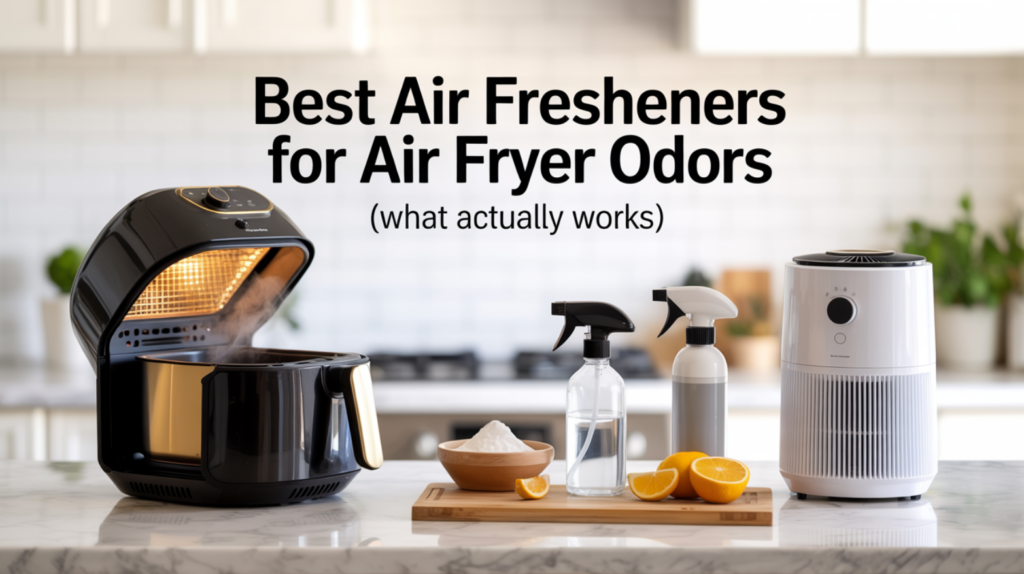
That’s why sprays and scented plug-ins often disappoint around air fryers. They can mask the smell briefly, but the next time the basket heats up, the odor returns, sometimes mixing with fragrance and grease in a way that feels even worse.
What “works” for air fryer odors (and what doesn’t)
The fastest way to pick the right solution is to separate odor removal from odor masking. Once you do that, the best options become obvious.
What works (odor removal)
- Activated charcoal (bamboo charcoal bags or carbon pouches) absorbs lingering cooking smells in the air around the appliance.
- Zeolite deodorizers trap odors effectively, especially in enclosed spaces like cabinets where the air fryer is stored.
- HEPA + carbon air purifiers reduce the overall “fried food” cloud in the kitchen after cooking.
- Ventilation + quick wipe-down routines stop odors from building up in the first place.
What usually doesn’t work (odor masking)
- Room sprays or aerosol fresheners near the cooking area can leave fragrance residue and make food smell “perfumey.”
- Scented gels and heavy plug-ins often blend with grease odor instead of eliminating it.
If your issue is more “chemical” than “food,” that’s a different category. In that case, the air fryer may have odor because a worn or heat-stressed part is reacting when it warms up.
The best “air freshener” options, ranked by real-world results
Most people want one simple product that works without turning the kitchen into a perfume shop. These options are ranked by how reliably they reduce air fryer odors in normal homes.
Activated charcoal bags (best overall for lingering fryer smell)
Activated charcoal binds odor molecules instead of covering them. It’s especially helpful when your air fryer sits on the counter and the smell lingers for hours.
How to use it well
- Place a charcoal bag near the air fryer, not inside it.
- Keep it where air moves, because airflow helps odors reach the charcoal.
- Refresh it occasionally according to the product instructions.
Best for: fish, frozen foods, bacon, and greasy “air fryer smell” that lingers overnight
Not great for: a smell that appears only when heating (that’s usually residue or a part issue)
Zeolite odor absorbers (best for storage smells)
Zeolite works well when the air fryer smells worst after you put it away. Odors concentrate when the drawer is closed and stored in a cabinet.
How to use it well
- Put the deodorizer in the cabinet or storage shelf near the air fryer.
- Keep it close to the basket and accessories so it absorbs odors at the source.
Best for: “stale fryer” smell when you open the drawer days later
Carbon + HEPA air purifier (best for the whole kitchen)
An air purifier doesn’t fix the air fryer itself, but it can make the kitchen feel fresh faster after cooking. This is especially useful in small spaces where smells spread quickly.
How to use it well
- Turn it on before cooking so it captures odors as they form.
- Place it a few feet away so it pulls air across the cooking zone.
Best for: apartments, open-plan rooms, frequent air frying
Mild, food-safe deodorizing routine (best “freshener” when the smell is in the machine)
If the odor is coming from inside the basket or drawer, absorption alone won’t fully solve it. The smell keeps returning because residue is being reheated.
A simple approach is to stick with a routine where the air fryer stays clean enough that it stops re-releasing smell, especially when you rely on deodorizing steps that avoid harsh chemicals and focus on gentle removal.
A quick “choose the right option” checklist
Choosing becomes easier when you match the tool to the exact moment the smell appears. The timing of the odor usually reveals the real cause.
Pick activated charcoal if…
- The air fryer smells fine when cold, but the kitchen smells after cooking.
- You want the surrounding air to feel clean again.
Pick zeolite if…
- The smell hits you when you open the cabinet or pull the basket out.
- The odor is trapped in storage.
Pick an air purifier if…
- Your whole kitchen holds onto cooking odors.
- You cook frequently and want a “background solution.”
Skip scented sprays if…
- You don’t want food to pick up fragrance.
- You’re trying to eliminate the source, not cover it.
Small habits that make any “air freshener” work better
Odor control improves when you reduce the source. These small habits feel satisfying because the air fryer starts to smell neutral again, even after heavier foods.
- Wipe the basket and drawer while still slightly warm (not hot) so grease lifts easier.
- Empty crumbs every session because burnt crumbs create sharp, smoky odors.
- Let the basket air-dry fully before storing, because trapped moisture holds old food smell.
- Store with airflow when possible so odors don’t concentrate.
Following the same logic across your whole setup becomes easier when you’re already building your routine from the complete air fryer odor guide and applying it consistently.
Conclusion
Air fryer odors aren’t mysterious. They come from heated residue, trapped cooking smells, or materials that react when warmed, and the only “air fresheners” that truly help are the ones that absorb odors or reduce them at the source.
If you want one simple choice that works for most kitchens, start with activated charcoal near the air fryer and pair it with a gentle deodorizing routine. Then, if the smell only shows up during heating or keeps returning no matter what, treat it like a fixable residue or part issue instead of a fragrance problem.