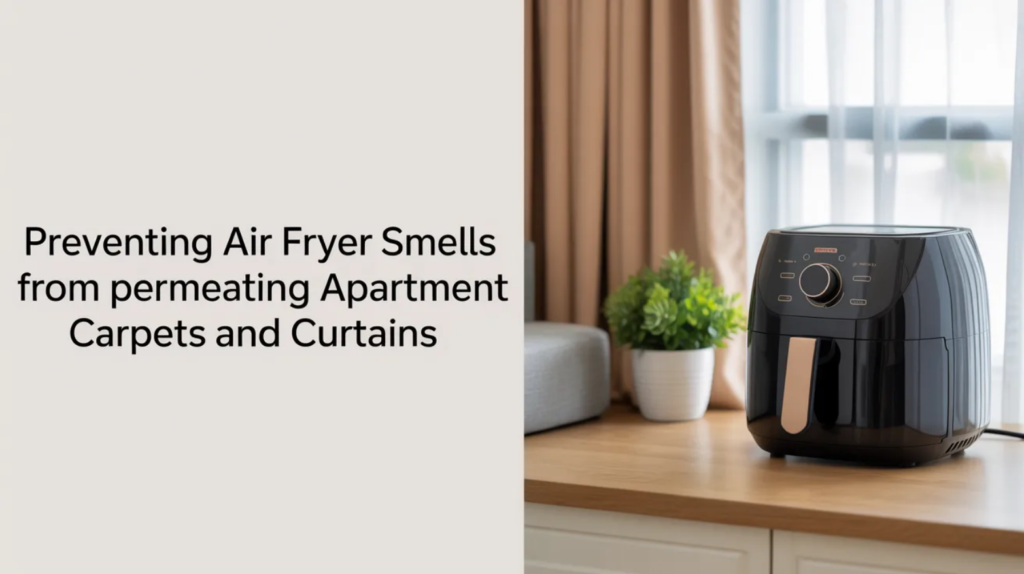
Air fryer smells cling to carpets and curtains because warm cooking exhaust carries grease particles that behave like microscopic sticky dust. When those particles land in fabric fibers, they don’t “go away” when the air clears, because the fibers hold oil and slowly release that odor again whenever the room warms up or the fabric moves.
First, decide if this is a “stop now” situation
Unplug and stop using the air fryer if the odor is burning plastic, electrical/ozone, or rubber, or if you see smoke, sparking, buzzing, melting, or a tripped breaker. That pattern suggests overheating parts, and fabric prevention won’t address the hazard.
If the smell is fried/greasy, stale oil, or strongly seasoned food and the unit runs normally, this is most commonly fabric absorption from airborne grease, which you can control.
The fabric problem in one sentence
Fabrics trap odor because grease particles settle into fibers, and fibers protect the oil from evaporating quickly, so the smell becomes “residual” instead of temporary.
If you want the underlying mechanism of how that oily haze forms and keeps cycling, the explanation in grease particles building up in the air connects the dots between cooking exhaust and long-term lingering smell.
Prevention plan: stop the landing, then remove what already landed
Instead of a long checklist, use this two-part approach. It works because it separates stopping new contamination from undoing old contamination, which need different actions.
Part A – Stop grease particles from landing on carpets and curtains
1) Create a “no-fabric zone” for cooking sessions
Move the fryer farther from curtains and rugs, or temporarily pull curtains back and roll a small rug edge away from the cooking area. Distance helps because particle concentration drops quickly as the exhaust plume disperses into open air.
2) Put airflow between the fryer and the fabric
A fan aimed from the fryer area toward your chosen exit reduces fabric exposure because it carries particles past the fabric before they can settle. This is especially important in windowless apartments, where how to ventilate apartment air fryer setups rely on directional flow rather than fresh outdoor air.
3) Keep doors closed where fabrics “store odor”
Closets, bedrooms, and laundry areas hold a lot of textiles. A closed door works because it removes the easiest pathway for greasy air to drift into those fabrics.
4) Reduce grease output at the source
High-fat foods and extra oil increase airborne grease, which increases fabric loading. The routine in minimize airborne grease focuses on cooking and airflow habits that lower how much oily mist is produced.
Part B – Keep odor from re-releasing from fabrics you already “loaded”
1) Break the “warm-room re-release” cycle
Residual odor spikes when the apartment warms because oil molecules volatilize more readily. Keeping the air moving during and after cooking reduces how much warm greasy air ever reaches the fabric, and it also lowers the chance of a next-day smell resurgence.
2) Treat the surrounding hard surfaces first
This sounds backwards, but it works because cabinets, walls, and nearby floors often carry a thin grease film that keeps re-contaminating the air and then re-settling into fabric. Wiping the nearest hard surfaces reduces the ongoing source that makes fabrics smell “impossible.”
3) Target fabric cleaning where it matters most
You don’t have to deep-clean the whole apartment. Focus on what sits closest to the fryer exhaust path: the curtain section nearest the cooking area, the rug edge that faces the fryer, and any upholstered seat within a few feet. That focus works because grease deposition is not evenly distributed; it’s directional.
(I’m intentionally not giving chemical mixing recipes or “spray this and that” hacks here, because the safest approach varies by fabric type and building rules, and some combinations can damage textiles or irritate lungs.)
Fast self-check: are your carpets/curtains the main culprit?
Use this quick test right after cooking:
- Sniff the curtain hem closest to the fryer and the rug edge nearest the cooking area.
- If those spots smell much stronger than the room air, the odor is in the fibers, not just floating in the room.
That clue matters because it tells you ventilation alone won’t solve it unless you also reduce fabric exposure.
What “good improvement” looks like
You’ll know this is working when:
- The apartment smell fades steadily after cooking instead of resurfacing later.
- Curtains don’t smell noticeably oily when you brush past them.
- Carpets near the cooking area don’t give off a stale “fried” note the next morning.
If you still get a next-day odor pop, it usually means either (1) airflow is still spreading particles before they exit, or (2) hard-surface grease film is continuing to re-seed the air.
For the full apartment-level strategy that ties ventilation, placement, and surface loading together, Air Fryer Smells in a Small Apartment (What Helps Without Windows) shows how these pieces interact so fabrics stop getting hit in the first place.
Calm recap and next step
Carpets and curtains hold air fryer odor because grease particles embed in fibers and re-release when conditions change. Preventing that means creating distance, building directional airflow, blocking textile-heavy rooms, and reducing grease output so less oily haze exists to settle.